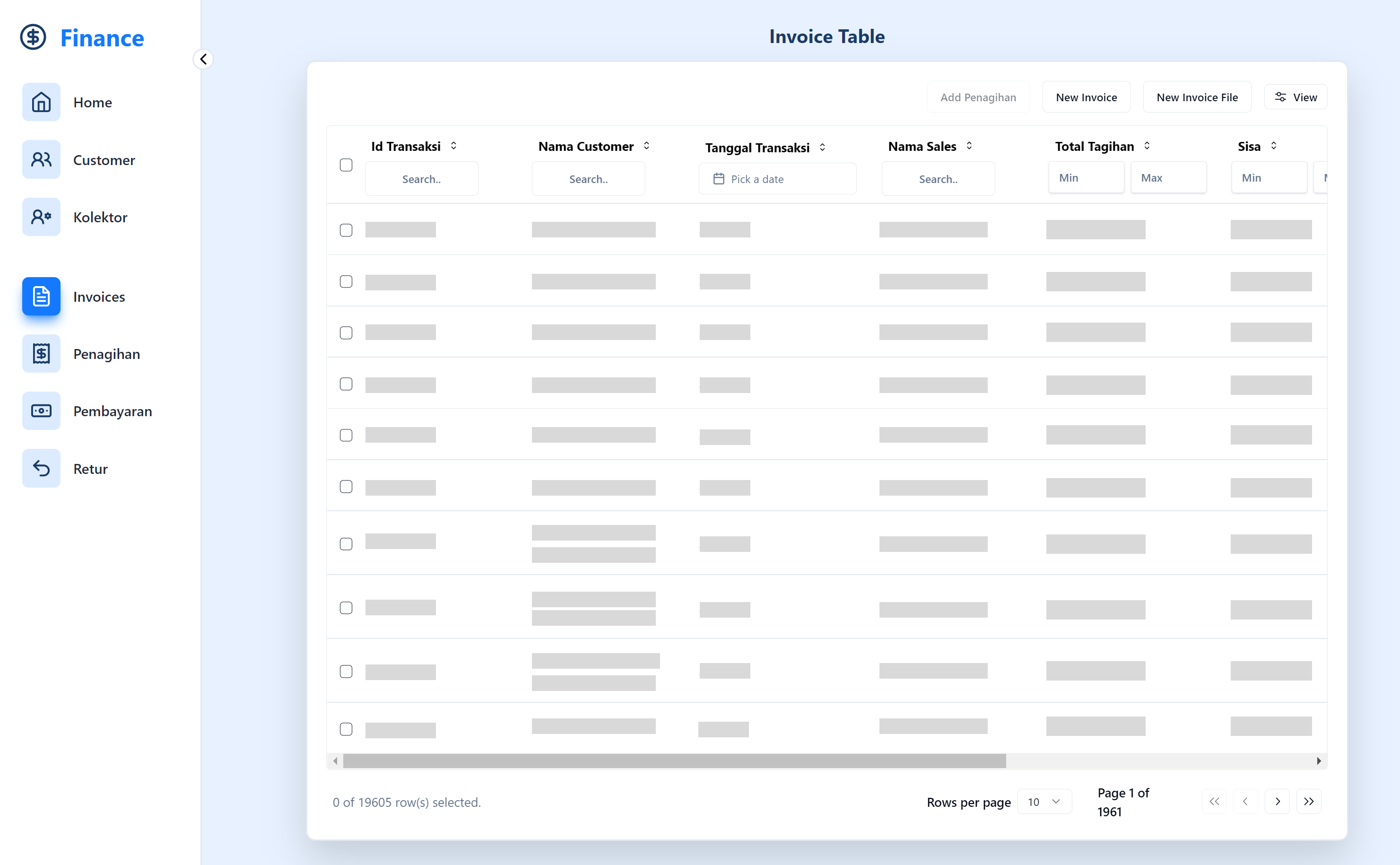
Project Goals
This project started from customer complaints about their current workflow: too many manual steps, unreliable connectivity, and slow reporting when the system had to depend on a remote server.
My goal was to convert those pain points into a technical solution that felt simple for users:
- Work reliably even when offline
- Keep data fast and local
- Sync/export when needed, without blocking daily operations
- Reduce repetitive work with clear, guided flows
I led a team of two, owning the technical direction while staying close to users to ensure each feature mapped to a real operational problem.
Features
- Transaction and invoice tracking. Track all transactions and invoices for every merchant, maintaining a complete audit trail of financial activities.
- Fast daily installment input. Streamlined data entry workflow for recording daily installments across multiple merchants, reducing input time and minimizing errors.
- Excel import and export. Quick Excel report generation and bulk data import via Excel format, enabling seamless integration with existing spreadsheet-based workflows.
- Offline-first workflow. Core operations run entirely on local storage so users aren't blocked by network issues.
- Guided data entry and validation. Reduced user mistakes by translating business rules into strict validation and helpful UI states.
- Fast local search and history. Lightweight querying patterns to keep results instant even as data grows.
Technology
This was my first time building a desktop app, so I optimized for a stack that balanced speed of development with stability.
Desktop App
- Electron for cross-platform desktop distribution
- React + TypeScript for UI and maintainable component architecture
- Vite for fast iteration during development
- tRPC for type-safe API communication between frontend and backend processes
Local Data Layer
- Prisma as the data access layer
- SQLite as the local database (offline-first)
Challenge
Converting customer pain points into clear technical requirements
The hardest part wasn’t coding—it was avoiding “feature guessing.” I ran short feedback loops, wrote down each pain point as a measurable outcome (time saved, fewer steps, fewer errors), then designed the UI + data model around that.
Complex aggregation: calculating total debt per merchant
One of the most challenging technical problems was computing accurate debt totals for each merchant. This required:
- Multi-table aggregations. Combining data from invoices, payments, returns, and collection records to calculate net debt.
- Real-time accuracy. Ensuring calculations reflect the latest transactions, installments, and payment distributions.
- Performance optimization. Making these complex queries fast enough for instant updates, even with thousands of records.
- Edge case handling. Accounting for partial payments, returns, multiple payment methods, and historical collector assignments.
Managing local database edge cases (different cases to manage)
Local databases introduce real-world complexity that's easy to underestimate:
- Data integrity. Preventing partial writes and keeping relationships consistent even when users close the app unexpectedly.
- Schema evolution. Planning for migrations and versioning as features change.
- Conflict and state issues. Handling "same record, different state" scenarios safely (draft vs submitted, edited vs finalized, etc.).
First time shipping a desktop app
Desktop brought extra concerns compared to web:
- Packaging and release flow
- OS-specific behaviors and permissions
- Crash recovery and resilient data handling
Outcome
- Shipped a desktop app that directly addressed the customer’s biggest operational blockers.
- Built confidence in desktop delivery (packaging, release, stability) while keeping development velocity.
- Established a foundation that can scale: clear architecture, typed codebase, and a local-first data model designed for real usage.